Casting Arc Guide: Matching Stroke Size to Line Length
Learn how to match your casting arc to line length — compact for a short line, wider for a long one — plus how to practise it at home.
Casting arc is the rod's whole rotation through a stroke — how far the rod head travels from the back of the backcast to the front of the delivery. It isn't a cast of its own, the way the overhead or the roll cast are — it's a quality that runs underneath every cast in this series, which is exactly why getting it wrong is one of the most common reasons a cast "feels a bit off" with no obvious cause.
The core idea is simple to say and easy to get backwards in practice: stroke size has to match how much line you've got out. A short line wants a compact stroke, a long line wants a wider one — and mixing the two up is the fault, far more often than any single stage of the cast itself.
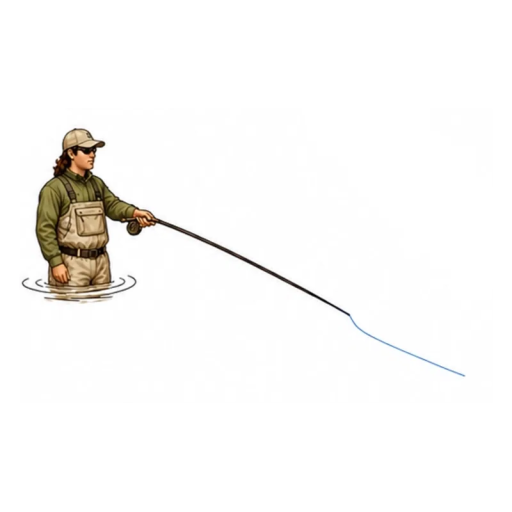
Why arc size has to track line length
The amount of line you have out determines how much resistance the rod actually feels through the stroke. More line out means more weight moving through the air, which means more resistance for the rod to bend against — and a rod under that much resistance can happily absorb a wider stroke without falling apart. Less line out means less weight and less resistance, so a wide stroke overpowers a rod that simply doesn't have enough load to work against.
As a rough guide: a short line wants a compact stroke, somewhere around 25–40°, with the hand travelling only a little. A long line wants a noticeably wider one, more like 60–90°, with the hand travelling further. Most real casting sits somewhere between the two, adjusting as line goes out or comes back in.
What happens when the two mismatch
Too small a stroke on a long line under-loads it — the rod doesn't get enough distance to build real line speed, so the stroke feels effortful for a limp, unconvincing cast. Too wide a stroke on a short line does the opposite: it over-throws a rod that has almost nothing to bend against, blowing the loop wide open and dumping the fly somewhere well short of where a tighter stroke would have put it.
Both faults are common for the same reason — both feel, from the inside, like reasonable effort. It's only the result that tells you the stroke size didn't match what was actually out.
It's not about power
Widening the arc doesn't add power on its own — it only helps if there's enough line out to actually load the rod through that wider path. Swing a big stroke over a short line and you're just moving the rod through more empty air, not building more line speed; all you've done is make the loop sloppier. The arc's job is to give the rod room to load properly for the line that's actually out, not to supply extra effort.
How to practise your casting arc without water
Arc size is a genuinely difficult thing to judge from feel alone — a stroke that's running noticeably too wide still feels "big and confident" from the inside, not obviously wrong, which is exactly why this fault survives so long in most casters' technique without ever being caught.
Fly Cast Coach measures the actual arc your stroke travels and compares it against a target for whatever line length you dial in, so instead of guessing from feel you get a direct answer: running wide, running narrow, or on target. It's one of the few faults here that's genuinely more of a numbers problem than a feel problem, which makes it a good one to let the sensors settle for you.
On your own, filming yourself side-on (or practising in front of a mirror) helps you actually see the stroke size rather than just feel it — try deliberately exaggerating a too-wide and then a too-narrow stroke so you have a felt reference for both extremes, then aim for the middle that matches your line length. As ever, the true test is a real rod loading against a real line — this practice builds the judgement for reading how much stroke a given length of line actually wants.
Sharpen your casting arc
Your phone becomes the rod — scored phase by phase, no water required.
Open Fly Cast Coach