Fly Casting Drills: 8 Practice Drills to Improve Every Cast
Eight practice drills for fly casting — timing, arc, wrist, tracking, accuracy and the double haul — each linked to a full step-by-step guide.
Most casting faults trace back to one of a small number of underlying qualities — timing, stroke size, wrist discipline, a straight path through the air — rather than being unique to any one cast. Drill these directly and every cast you already know gets better at once, roll and Spey included, because you're fixing the shared foundation rather than patching each cast separately.
The eight drills below are the ones that come up constantly across real casting instruction, each aimed at one specific, checkable quality. Work through them in any order — most casters find one or two that expose a fault they didn't know they had.
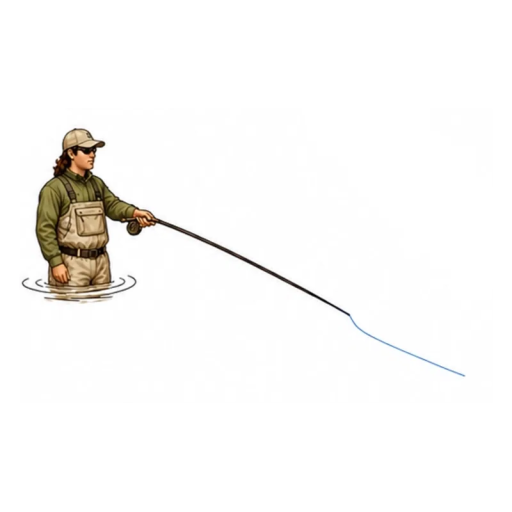
1. The pause-timing drill
Count "one" silently after your backcast stop before starting forward. It won't teach you the exact pause a real cast needs — that depends on line length and how long the loop takes to straighten behind you — but it directly targets the single most common beginner habit: starting forward before the backcast has finished.
2. The casting-arc drill
Practise deliberately exaggerating a too-wide, then a too-narrow stroke, so you have a felt reference for both extremes — then aim for the middle that actually matches your line length. Arc size is one of the hardest faults to judge from feel alone.
3. The frozen-wrist drill
Keep the wrist deliberately locked for most of the stroke — hand and forearm only — and let it unlock just at the very end, into the stop. Exaggerating a frozen wrist, even past the point of feeling natural, is the fastest way to feel where "late" actually is.
4. The straight-line tracking drill
Prop your phone (or a camera) a few feet behind you and film your rod tip travelling straight down your own sight-line, then compare the backcast and forward-cast lanes frame by frame — a side-on view actually hides this fault, since sideways drift happens on the axis running toward and away from the camera. Tracking faults are close to invisible from the caster's own seat too — the stroke feels identical every time even when the rod is drifting off-line.
5. The fence drill
Cast with a fence, hedge or wall a rod's length behind you. Catch it on the backcast and your stop is coming in too low or too wide — an old, simple check that needs nothing but something solid behind you and a willingness not to actually hit it.
6. The roll-cast setup drill
Practise side-lift-hold on its own, slowly, with no delivery at all, until it feels like one calm movement rather than three separate ones. The roll cast's setup is where most casters rush without noticing — the delivery is rarely the actual problem.
7. The double-haul timing drill
Rehearse the arm pattern alone first: rod hand accelerating to a stop, line hand pulling down in the same beat, then feeding smoothly back during the pause — before ever adding a real line. The double haul is won or lost entirely on whether the two hands agree on the beat.
8. The accuracy-target drill
Lay a hoop, towel or paper plate on the lawn and try to land your leader tip on it, cast after cast. This is the classic bridge drill between technique practice and real fishing — it's the first time "was that cast good" gets an honest yes-or-no answer instead of a feeling.
Practise these drills, scored
Fly Cast Coach reads several of these drills directly — pause timing, arc, wrist, tracking and the double haul — phase by phase, on your phone.
Open Fly Cast Coach