How to Practise Fly Casting at Home (No Water Required)
You don't need a river to get better at fly casting. Real drills, real technique, zero water — plus how to bring your practice to your next lesson.
The usual problem isn't wanting to get better at fly casting — it's finding the time, the water, or the season to actually do it. Rivers close for winter, lakes are an hour's drive, and a lot of casting time gets lost simply because getting to real water is its own small project. The good news: the part of casting that actually improves with repetition — the timing, the pause, the stop — is a motor skill, and motor skills are trainable anywhere you can swing an arm.
That's not the same as saying you don't need water at all. You do, eventually — dry practice can't show you your loop shape, whether your fly landed where you meant it to, or how a real line behaves in real wind. What it can do is fix the part that's genuinely hard to feel even standing in a river: whether your timing was actually right, not just whether the cast felt fine.
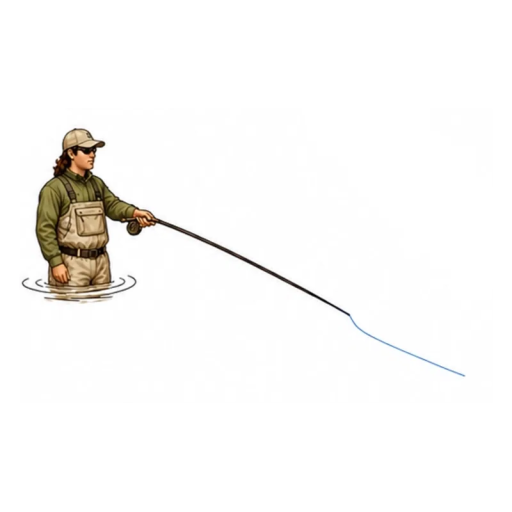
Phone or iPad — works right now, in your browser
You don't need to install anything to start. Open flycastcoach.com on your phone's browser — Android or iPhone, either one — and it works immediately: hold the phone like the rod, and every stop, pause and stroke gets scored live as you swing it. iPhone users can add it to the Home Screen afterwards so it opens full-screen like a regular app, but that's a convenience, not a requirement.
An iPad works too, and it's a genuinely good fit for the two-handed casts — Spey and Double Spey. Fly Cast Coach recognises an iPad automatically and switches to two-handed grip guidance throughout: hold it with both hands, the way you'd hold a longer two-handed rod, rather than one-handed like a phone.
The iPhone app and Apple Watch mode
The native iPhone app is on the App Store, listed as Fly Cast. It plugs into Apple's own motion sensors more directly than a browser can, which means meaningfully more precise tracking — the kind of thing that unlocks drills a browser's sensors are too noisy to score reliably, like checking whether your stroke is actually travelling in a straight line.
The iPhone app also brings Apple Watch support. Strap the Watch onto your casting hand — not your everyday wrist, your casting one — and hold an actual rod instead of a phone. The Watch reads every stroke straight from your wrist while your phone sits on a bench or in your pocket showing the feedback. That's real casting-arm movement with a genuine rod in your hand: the butt end of an old rod is enough for a living-room session, or take a full rod out into the garden and make real casts, scored the same way. Just leave the hook or fly off either way.
Why dry practice actually works
A fly cast is really a sequence of small, precisely-timed decisions — when to stop, how long to pause, how late to let the speed build — and every one of those decisions lives in your arm and your timing, not in the water underneath you. You can rehearse the exact motion of a roll cast's setup, an overhead's pause, or a double haul's two pulls without a single foot of line actually flying anywhere, because what you're training is the movement pattern, not the flight of the fly.
This is exactly why so many working instructors already teach part of a first lesson on dry grass before ever wetting a line — it lets a beginner get the feel of the stop and the pause without the added complexity of managing a real rod, line and leader all at once.
What you actually need
Not much. A patch of open space — a garden, a park, even a hallway with a bit of headroom — is enough, since you're grooving a movement, not casting for distance. Many casters practise with an old rod strung with just a leader and no fly at all, which lets you feel a real rod bend without any hook risk. Just as many practise with nothing but their own arm, miming the motion, which works fine for timing-only drills like the pause count. Whatever you use, the one real requirement is space clear of people, pets and anything overhead.
Three classic dry-land drills
The pause-count drill: after your backcast stop, count "one" to yourself before starting forward — out loud at first, then silently. It won't teach you the exact pause a real cast needs — that depends on line length and how long the loop actually takes to straighten out behind you — but it directly targets the single most common beginner habit: starting forward before the backcast has finished. That habit is just as easy to drill on a lawn as it is to fix on a riverbank.
The fence drill: practise your backcast with a fence, hedge or wall a rod's length behind you. If your backcast catches it, your stop is coming too low or too wide — a classic, well-worn beginner check that gives you honest, immediate feedback with nothing more than something solid to (carefully) not hit.
The mirror drill: face a mirror, or film yourself side-on with your phone, and check your stop positions directly rather than trusting how they felt. Clock positions are easy to say and surprisingly easy to drift past without ever noticing — seeing them is a different, more honest test than feeling them.
Bringing your practice to a real lesson
If you're working with a real instructor, dry practice is worth bringing into the room with you, not just doing on your own beforehand. A quick screenshot of your Fly Cast Coach progress — your streak, your best reps, which phase of the cast you've been working on — gives an instructor something concrete to start from, rather than watching one cast cold and guessing where to focus. "I've been drilling the pause all week and my timing's still inconsistent" is a far more useful opening line than "can you check my cast?"
This is something you can do today with nothing more than your phone's screenshot button — show your instructor what you've been working on, not just what you can currently do. It's a small thing, but it turns a general lesson into a targeted one.
Start practising today
Your phone becomes the rod — scored phase by phase, no water required. Free to start with the overhead cast.
Open Fly Cast Coach