How to Double Haul: The Complete Step-by-Step Guide
Learn the double haul — the line-hand technique that adds real distance to any fly cast — and how to practise the timing at home.
The double haul isn't a cast of its own — it's an addition layered onto a cast you already know, most often the overhead. Where every cast so far in this series has been about the rod hand alone, the double haul brings your line hand into the timing for the first time, pulling sharply on the line at exactly the moment the rod is accelerating toward each stop. Done well, it adds real line speed and real distance. Done at the wrong moment, it does almost nothing — which is what makes it a technique that's genuinely about timing, far more than it's about strength.
It's most associated with distance casting and saltwater fly fishing, where extra line speed matters for punching a fly into wind or covering more water, but the same hauling motion turns up across the sport — it's just as relevant the day you need a bit more out of an overhead cast on a breezy bank. Fly Cast Coach checks it by pairing your phone (rod hand) with an Apple Watch on your line-hand wrist, so it can tell whether the haul actually landed on the beat, not just whether you moved your arm.
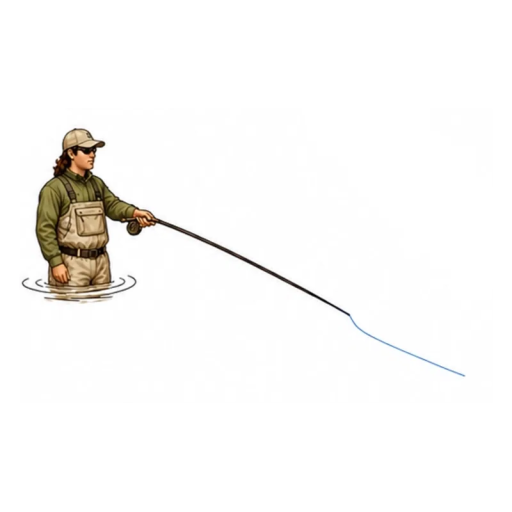
What the haul actually adds
A fly rod's own acceleration through the stroke is only part of the total line speed in a cast — the double haul adds a second source. As the rod hand accelerates the rod toward a stop, the line hand pulls down sharply on the line at the same moment, and that extra pull adds directly to how fast the line is travelling when the loop forms. More line speed means a tighter loop that carries farther, with less effort from the rod arm alone.
None of this is exotic physics — it's the same idea as a rope running through a pulley: pulling one end while the system is already moving adds speed to the whole line, not just the section in your hand.
The haul on the backcast
As the rod accelerates back toward the backcast stop, pull the line hand down and away in one sharp, short movement — timed to finish right as the rod stops. A haul that arrives early or trails late doesn't add speed to the stroke it was meant to help; it just becomes a separate, disconnected tug.
The pause: feeding the line back
Between the two hauls, the line hand has to give back what it just pulled — smoothly, not in a jerk, sliding back up toward the rod as the line unrolls. Rush this or let it stay yanked down, and there's no line left to haul on the way forward, which quietly kills half the technique before the forward stroke has even started.
The haul on the forward stroke
The same sharp pull happens again as the rod accelerates forward toward its stop — timed to the forward acceleration exactly the way the first haul was timed to the backcast. Two hauls, same idea, mirrored: pull as the rod speeds up, ease off as it stops.
Timing: the part that's genuinely hard to feel
Everything above is simple to describe and surprisingly hard to feel from the inside. A haul that's a fraction early or late still feels like "I hauled" to the person doing it — the arm moved, the line pulled — but a mistimed haul barely helps the cast at all, and an especially early or hard one can even disrupt the loop it was meant to tighten. This is exactly why the double haul has a reputation for taking longer to learn than any single cast in this series: the movement itself is simple, but the two hands have to agree on a beat that neither of them can watch the other one make.
This is also the one skill in Fly Cast Coach that checks two hands at once rather than one. Pair an Apple Watch on your line-hand wrist (beta) and the app compares your line hand's timing directly against your rod hand's, rather than trusting either hand's own sense of when it moved.
How to practise the double haul without water
Because the whole difficulty here is timing between two hands rather than the strength or shape of either one alone, the double haul is arguably the single technique in this series that benefits most from an outside read on what actually happened — your hands agreeing that they moved doesn't tell you whether they agreed on the beat.
That's the specific gap Fly Cast Coach's Watch-paired mode fills: your phone reads the rod hand's acceleration the same way it does for the overhead cast, your Watch reads the line hand's pull, and the app checks whether the two lined up — not too early, not too late — rather than scoring either hand in isolation.
Even without a Watch, it's worth rehearsing the arm pattern on its own first: rod hand accelerating to a stop, line hand pulling down in the same beat, then feeding smoothly back during the pause, before ever trying it with a real line. A mirror helps you check that the two movements are actually simultaneous rather than one trailing the other. And as with every skill here — this builds the coordination and the timing; a real double haul still needs a real line's weight and a real rod's load to show you what it actually does to a cast.
Try the double haul
Your phone becomes the rod — scored phase by phase, no water required.
Open Fly Cast Coach