How to Double Spey Cast: The Complete Step-by-Step Guide
Learn the double Spey cast step by step — the waterborne-anchor cast for an upstream wind — plus how to practise the movement at home.
Reach for the double Spey when the wind is moving upstream — blowing against the current, across your body from your rod-arm side toward your face. That's exactly the wind that would blow a single Spey's touch-and-go anchor away before you could deliver. The double Spey solves it with a waterborne anchor instead: the line stays in contact with the water throughout the sweep and D-loop formation, held there by surface tension against the wind, rather than briefly touching and lifting off.
As with the single Spey, everything below describes a right-hander on the left bank; on the opposite bank, or fishing left-handed, the whole cast mirrors. In a genuinely strong upstream wind, a cack-hand cast — casting over your opposite shoulder — is often the safer option, since it puts your body between the wind and the D-loop rather than the other way round.
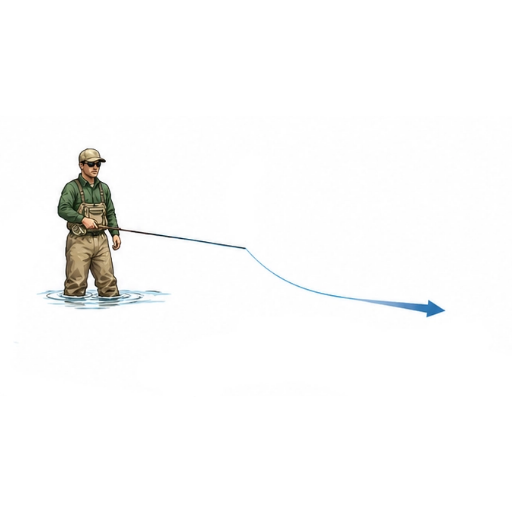
Where the anchor lands
The anchor lands close to you, on your rod-arm side — roughly a rod's length away, level with your front foot. It's easy to assume the fly ends up wherever the rod tip travels during the lift-over, but it doesn't: the rod tip goes up and over toward the upstream side, while the fly itself comes to rest on your rod-arm side. Getting comfortable with that distinction early saves a lot of confusion later, because the entire first half of this cast is really just the setup for that one anchor placement — everything after depends on it landing correctly.
Low start and the vertical lift
Start with the rod tip low and still, the line lying straight downstream. Then lift slowly and vertically — no snatch, and no early wrist. This vertical lift is what frees the line from the water before you take the rod up and over toward the upstream side.
Lift up and over
Continue the lift up and over toward the upstream side. This is a repositioning stroke, not a loading one: the rod tip travels upstream and throws a small loop of line up and over, so the fly ends up resting close to you, on your rod-arm side. Keep the whole movement calm and unhurried — rush the lift-over and you'll throw a bad anchor placement that nothing later in the cast can fix.
Place the waterborne anchor
Lower the rod tip and let the line settle onto the water, calmly. The fly comes to rest close to you, on your rod-arm side — about a rod's length away, roughly level with your front foot. That side is non-negotiable: get the anchor on the wrong side and the delivering line has nowhere to go but across your body or your face, which is the one genuinely safety-critical point in this whole cast.
This is also, by a wide margin, the moment most casters rush. The double Spey doesn't reward a dropped or stabbed placement — it wants a settled one, calmly delivered — and a good placement here is what lets the sweep and circle-up actually work later. Slow this part down and the rest of the cast tends to fall into place on its own.
The shallow, inclined sweep
Once the anchor's placed, peel the line off the water and sweep the rod up on a shallow incline. Don't stop dead right after placing the anchor, and don't drive the sweep in flat — a clean, shallow incline is what carries the sweep smoothly into the round that follows.
Sweep round and up
Continue the sweep farther round and up, into the D-loop setup. Shortcutting this or stopping dead partway through is the fault to watch for — the farther you carry the rod round, the more room the circle-up has to actually load the rod for the delivery.
Circle up over the anchor
As the rod passes over the anchor at the end of the sweep, circle it up — a rising, curved path that forms the D-loop and sets the key position. Pulling straight back flat rather than circling up is the common mistake; the upward circle is what loads the rod for what comes next.
Forward delivery: speed late, stop high
From the key position, deliver with one smooth forward stroke, the speed building late, and finish with an abrupt, high stop. The crisp, high stop forms the loop and carries the line out — a soft or low stop lets the whole cast collapse. Hold the stop for a beat.
The full cast, together
Combine the whole sequence: start low, lift vertically, take the rod up and over so the fly settles on your rod-arm side, peel the line off and sweep on a shallow incline, carry it round and circle up over the anchor, then deliver forward to a high stop. Keep the whole thing calm throughout — the double Spey is more deliberate than the single Spey, and the anchor placement is genuinely the whole first half of the cast.
How to practise the double Spey cast without water
More than any other cast here, the double Spey is won or lost in a single, unglamorous moment: the calm placement of the anchor. Everything after it — the sweep, the circle-up, the delivery — is just following through on whatever that placement set up. And it's precisely the part most casters rush without realising it, because a hurried placement doesn't feel dramatically different from a calm one in the moment; it only shows up in how the rest of the cast behaves.
Fly Cast Coach reads the whole sequence as connected phases — the vertical lift, the lift-over, the calmness (or lack of it) going into the anchor placement, the shallow sweep, the circle-up, and the final stop — so it can flag specifically if the setup is rushed, rather than only scoring the cast as a whole. Given how much of this cast rests on that one moment, that phase-by-phase view matters more here than almost anywhere else in the app.
On your own, it's worth deliberately practising the lift-over and anchor placement in isolation, slowly, before adding the sweep and delivery back on — get comfortable with calm arriving there before you ask for calm throughout the whole cast. A garden or open room is enough space for the movement itself. And as with every cast here: this builds the timing and the touch for the setup — a real double Spey still needs a real anchor holding against real moving water to actually work.
See it on the water
How this cast actually gets used fishing a real river — from our sibling app, Rise Daisy:
Practise the double Spey
Your phone becomes the rod — scored phase by phase, no water required.
Open Fly Cast Coach