How to Jump Roll Cast (Switch Cast): Step-by-Step Guide
Learn the dynamic jump roll cast — also known as the switch cast or dynamic roll cast — for extra distance on tight banks, plus how to practise it at home.
Reach for the jump roll when a static roll cast simply won't reach far enough, but you still have no room behind you for a backcast. It's a dynamic roll cast: instead of staying stuck to the water the whole time, the line briefly aerialises mid-cast, which means more of it ends up loading the rod — and that's where the extra distance comes from.
You'll hear this cast under a few different names depending on where you learned it. "Jump roll" and "dynamic roll cast" are the terms most commonly used in the British Isles — AAPGAI, the UK's own casting-instructor body, publishes it under that same name — while in Continental Europe it's more often called the switch cast. Regional naming aside, it's the same underlying movement, and it's also, usefully, the bridge to single-handed Spey casting. The pull-and-sweep movement you're about to learn is the same basic shape you'll meet again in the single Spey, just without the change of direction — so time spent here pays off twice.
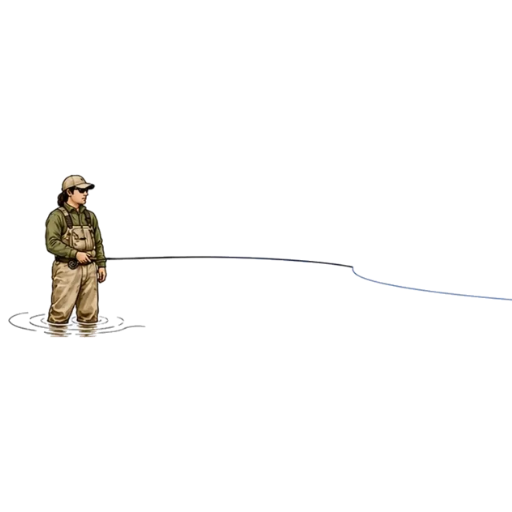
Low start and slack control
Begin with the rod tip low, close to the surface, and the line lying straight in front of you. Minimal slack here is what lets the rod load cleanly the instant you pull back — any slack in the line is slack the rod can't use. Hold still for a beat before you begin the pull.
The inclined pull back
The first real move is a pull backward on an inclined path, driven from the elbow, that loads the rod through the water's own resistance on the line. Start it smoothly and let it build — don't snatch or rip the line free.
The angle of that pull matters more than it looks like it should. Too flat, and the pull drifts sideways instead of loading properly. Too steep, and the line lifts clean off the water rather than dragging against it — which means the anchor is gone before the forward stroke can ever use it. A smooth, progressive pull on a genuine incline is what loads the rod cleanly for everything that follows.
Let the line sweep back
As the rod unflexes, the line aerialises and sweeps back and round toward where the anchor will form. The one thing to avoid here is stopping dead after the pull — keep the movement flowing back and round so the D-loop can form on the move rather than in a held position. A dead stop at this point kills the dynamic loading that makes the jump roll worth learning in the first place.
Circle up over the anchor
As the rod tip passes over where the anchor's forming, circle it up and round — a rising, curved path that both shapes the D-loop and helps place the anchor smoothly. Pulling straight back flat instead of circling up is the common fault here; the upward circle is what actually sets the key position.
Keep the anchor on your casting-arm side throughout. Land it across your body instead, and the delivery has nowhere to go but through you.
Fluid tempo — no true pause
Unlike the static roll cast, the jump roll has no real held pause — but the D-loop still needs a genuine moment to form behind you. So the transition from the circle-up into the forward delivery has to be fluid and well-timed: not a dead stop, not a long static hold, and not a rush either. Let the loop form on the move, then go.
Forward delivery: speed late, stop high
Move the hand forward, rotate through the stroke with the speed building late rather than all at once, and finish with an abrupt, high stop. That crispness at the stop is what transfers the energy and shapes the loop — a soft or low stop lets the whole cast collapse right at the end. Hold the stop for a beat once you've made it.
The full cast, together
Combine the whole sequence: low start, an inclined pull back, letting it sweep round, circling up over the anchor, then delivering forward to a high stop — all of it flowing, with no dead stop anywhere in the middle. Pull, sweep, circle, forward, stop. The setup is what makes this cast work, so keep it smooth and give the D-loop room to form on the move rather than forcing it.
How to practise the jump roll cast without water
The jump roll's whole personality is continuity — a single flowing movement with no dead stop anywhere in the setup. That's precisely the kind of fault that's nearly invisible from inside your own cast: a small hesitation after the pull, or a beat too long circling up, feels like nothing while you're doing it, but it's exactly what kills the dynamic loading the cast depends on.
Because Fly Cast Coach scores the shape of the whole movement — not just the final stop — it's well suited to exactly this problem. It reads the pull, the sweep, the circle-up and the delivery as connected phases and will flag it specifically if the flow breaks down somewhere in the middle, rather than only telling you the final cast felt weak.
As a dry-practice checkpoint on its own: try running the pull-sweep-circle sequence in slow motion first, checking for any point where the movement genuinely stops rather than just slows, before adding speed back in. A garden or open room with a bit of overhead clearance is plenty of space, since you're grooving the shape of the movement rather than casting real distance. And, as always, this builds the timing and the feel — the actual water-loading and loop mechanics are still something only a rod, line and bank can teach you.
Practise the jump roll
Your phone becomes the rod — scored phase by phase, no water required.
Open Fly Cast Coach