How to Overhead Cast: The Complete Step-by-Step Guide
Learn the overhead fly cast step by step — grip, lift, backcast, pause and delivery — plus how to practise it at home without a rod, line or water.
Every fly caster starts here. The overhead cast is the one you reach for whenever you've got open water behind you and room to swing a rod through the air — and it's also the cast every other cast either borrows from or exists to get around. Learn this one properly and the roll cast, the Spey casts, all of it, come easier, because the underlying mechanics never really change. Only the shape of the setup does.
Before any of the steps below, it helps to understand what's actually happening in your hand. A fly rod is a spring. It bends under the weight of the line moving through the air, storing energy, and it fires that energy back into the line the instant you stop the rod dead. You're not throwing the fly — you're barely even throwing the line. You're loading a spring and releasing it cleanly, twice: once on the backcast, once on the delivery. Every step below is really just one of two questions, asked twice — how do you load the rod without spilling the energy, and how do you stop it crisply enough to let that energy go where you want it.
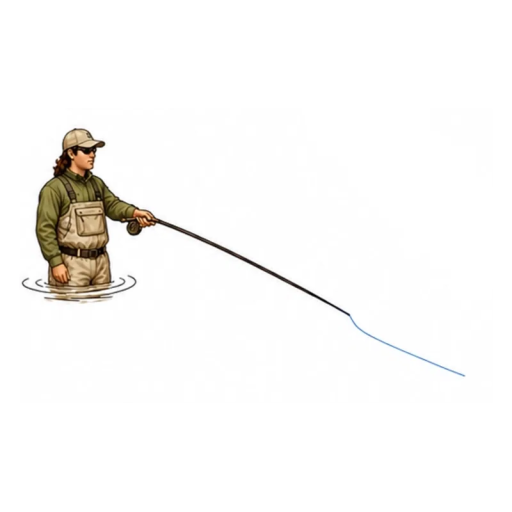
Grip and the ready position
Start with the rod tip low, close to the water, and the line lying straight out in front of you. Any slack at this point is wasted before the cast has even begun — a fly rod loads through tension, and slack line is tension the rod can't feel yet. So before you move at all, take up that slack: point the rod at the line, not off to one side, and let it lie dead straight.
Hold the grip the way you'd shake hands with it — thumb on top, not wrapped underneath, so it can act as a stop against your own forward push later in the cast. Nothing about the ready position should feel like effort. It's a held moment, not a braced one.
The lift: loading the rod
Raise the rod smoothly and let the speed build as you go — don't snatch it off the water. As the line peels free, the rod begins to bend, and it's the smoothness of that lift, more than its size, that decides how cleanly the load builds. A jerky lift throws slack into the line before the rod's even had a chance to use it.
Think of the lift as the quiet half of the cast. Nothing here needs to be fast. It only needs to be even.
The backcast: through the vertical
From the lift, accelerate the rod up and back, carrying it through the vertical. The path the tip travels matters more than most beginners expect — it should be a straight, flat line through the air, not a curve. A rod tip that dips and then rises again on its way back draws a slightly concave path, and that's the classic cause of a tailing loop: the line crosses itself in the air instead of following a clean, open loop behind you.
The speed should be building the whole way through this stroke, not sitting flat and then spiking at the end. Save the real acceleration for the very end of the stroke, right before the stop.
The back stop: one o'clock
Stop the rod crisply at around one o'clock. That sudden stop — not the size of the stroke before it — is what actually unloads the rod and throws the line out behind you. A vague, mushy stop bleeds the energy out gradually instead of releasing it all at once, and an open, weak loop is what you get for it.
It helps to think of the stop as a single decision rather than a deceleration. You're not slowing the rod down. You're arriving at a point and stopping dead.
The pause: timing by feel
After the back stop, the line unrolls behind you and straightens out — and this is the part almost every beginner rushes. Come forward too soon and you'll crack the line like a whip, because the rod hasn't finished loading against a fully extended line yet. Wait too long, until the line is completely straight and starts to tug the rod tip backward, and you've let the load bleed away entirely; the forward stroke then has to start from nothing.
The window between those two mistakes is real but narrow, and it's exactly what Fly Cast Coach was built to teach — the app counts you down (three, two, one) and you begin the forward stroke just after "one," so your reaction lands the stroke right as the line comes tight, a beat before it would otherwise give you a tug.
The forward stroke: build the speed late
Come forward with one smooth acceleration, and save the real speed for late in the stroke — never punch from the very start. A stroke that's fast everywhere is actually the same as a stroke that's fast nowhere in particular; without a clear point where the speed peaks, the loop opens up and the cast loses both distance and accuracy.
A useful image: you're not swinging the rod forward so much as squeezing the speed onto it, a little more with every inch, right up to the stop.
The forward stop: ten o'clock
Stop the rod high, at around ten o'clock. This crisp stop is what forms the tight forward loop that actually carries the line out to the target — stop low, or let the rod drift on past the stop instead of arresting it, and the loop opens and collapses, taking your distance with it.
If the backcast stop taught you anything, it's this same lesson again: the stop is the cast. Everything before it is preparation.
Presentation: the quiet finish
As the line unrolls forward and starts to fall, let the rod tip follow it down, settling the fly gently onto the water rather than slapping it down. A soft finish lands the fly first, and straight — which matters more than it sounds like it should, because a fly that lands first and clean is a fly a fish hasn't already seen the leader crash down next to.
How to practise the overhead cast without water
The overhead cast lives or dies on two things you can't easily see on your own: the pause, and the stop. Neither one is really about strength or even about the rod — they're about timing and touch, which is exactly why they're so hard to self-correct standing in a river with only your own sense of "that felt about right" to go on.
That's the actual gap Fly Cast Coach fills. Hold your phone the way you'd hold a rod grip, run through the motion, and its motion sensors read the shape of your stroke the same way a rod tip would — how smoothly the lift built, how the timing of your pause lined up against the line straightening out, how crisp the two stops actually were. You get a phase-by-phase readout rather than a single pass/fail number, so you know which part of the cast to work on next, not just that something felt off.
A few things help even without the app in hand. Practising in front of a mirror lets you actually see your stop positions — one o'clock and ten o'clock are easy to say and surprisingly easy to drift past without knowing it. A patch of open garden or a park with nothing overhead works fine; you're training a movement pattern, not distance, so you don't need real casting room, just enough space to swing an arm without hitting anything. And it's worth saying plainly: none of this replaces time with a real rod, a real line, and a real loop shape to watch. What dry practice teaches you — the timing, the pause, the stop — is the part that's genuinely difficult to feel on your own; the river is still where you learn the rest.
See it on the water
How this cast actually gets used fishing a real river — from our sibling app, Rise Daisy:
Practise the overhead cast
Your phone becomes the rod — scored phase by phase, no water required.
Open Fly Cast Coach