How to Roll Cast: The Complete Step-by-Step Guide
Learn the fly-fishing roll cast step by step — anchor, D-loop, and delivery — for tight banks with no room for a backcast, plus how to practise it at home.
Reach for the roll cast the moment the bank behind you closes off the backcast — trees, a cliff face, a wall of alders, or just a friend fishing too close for comfort. It's the cast that lets you fish water an overhead cast simply can't reach, for the plain reason that the line never leaves the water behind you at all.
Where the overhead cast loads the rod against thin air on the backcast, the roll cast loads it against the water itself. Two terms you'll meet constantly here, and in every cast after it: the anchor is the part of the line still resting on the water — it's what the rod loads against, in place of a backcast. The D-loop is the loop of line hanging in the air behind you once your setup is in place; the bigger and cleaner it is, the more energy your forward stroke has to work with. Get comfortable with those two ideas and the roll cast — along with Spey casting later on — starts to make a lot more sense.
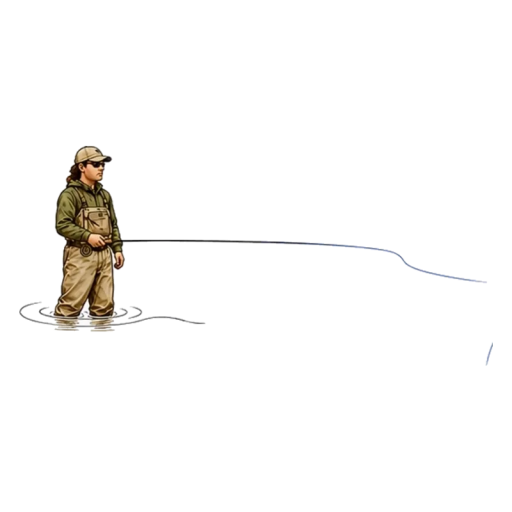
Rod tip low: the still start
Begin with the rod tip low and close to the water, and hold it there, still, for a beat. A steady, low start gives the whole cast a clean reference point — everything that follows is a departure from this position, so if this position drifts, the rest of the cast drifts with it.
Side placement: setting up the anchor
From that low start, move the rod out to the side, so the line sits just outside your casting lane. This is what actually sets the anchor down in the right place. Keep the movement calm and compact — a side placement that's too wide or too rushed throws the anchor off before the lift has even begun, and there's no fixing that later in the cast.
Lift to the key position
From the side, lift the rod smoothly up toward the key position — the loaded stance you'll cast from. The lift should feel gradual, never a snatch. A smooth lift draws the line up into a clean D-loop behind you; a jerky one collapses it before it's properly formed. Lift high enough to load the rod, but keep the whole movement compact rather than throwing it wide.
Set the D-loop and hold
At the top of the lift you reach the key position — the setup proper. Hold it there for a short beat while the anchor and D-loop settle. Don't let your hand creep forward, and don't rush straight into the delivery from here.
Where you hold it matters as much as how long: keep the D-loop out to the side and clear of your body. Set it up directly in front of you instead, and the delivery has nowhere to go but across you or straight into you — which is as much a safety point as a technical one. Set, hold, then move.
Move forward, then rotate
Start the delivery with a short move of the hand forward — not with the rotation. That small forward move keeps the rod loaded before the rotation adds its speed. Rotate too early, straight from the held setup, and you hit the cast from a standing start, which opens the loop and dumps the line short of where you wanted it.
Rotate to a high, crisp stop
After the forward move, rotate the rod through, building the speed late, and finish with an abrupt, high stop. That crisp stop is what forms the tight forward loop that actually rolls the line out across the water. A soft stop, or one that finishes too low, lets the whole cast collapse before the line's gone anywhere.
The full cast, together
Put the whole sequence together as one flowing idea: a calm setup — side, lift, set — flowing into a clean delivery — forward, rotate, stop. The setup half should feel entirely unhurried; the power arrives late, in the delivery, not at the start. Resist the urge to throw the cast from the very beginning — let it build all the way to that final high stop.
How to practise the roll cast without water
The roll cast asks for something the overhead cast doesn't: real patience in the setup. Side placement, the lift, the held key position — three separate movements that have to stay calm and compact, in sequence, before the delivery ever starts. Rushing any one of them is invisible from the caster's own seat, because it's your hands that feel busy, not your eyes that see the anchor sliding out of place.
Fly Cast Coach reads that setup sequence the same way it reads an overhead cast — hold your phone like a rod grip and its motion sensors track the shape and timing of the side placement, the lift, the held setup, and the rotation into the stop, phase by phase rather than as one lump score. You'll see specifically whether it's the setup that's rushed, or the delivery, or the stop — which is usually the part a caster genuinely can't tell from the inside.
It's worth practising the setup on its own, slowly, with no delivery at all, until side-lift-hold feels like one calm movement rather than three separate ones. A mirror helps here too — you can actually watch whether the D-loop position (out to the side, clear of your body) is where you think it is. And as ever, this trains the movement, not the water-loading physics behind it; take the timing you build here straight to a real anchor on real water as soon as you can.
See it on the water
How this cast actually gets used fishing a real river — from our sibling app, Rise Daisy:
Practise the roll cast
Your phone becomes the rod — scored phase by phase, no water required.
Open Fly Cast Coach