How to Single Spey Cast: The Complete Step-by-Step Guide
Learn the single Spey cast step by step — the quickest change-of-direction cast for a downstream wind — plus how to practise the movement at home.
Reach for the single Spey when you have a bank behind you, the line's lying downstream, and the wind is moving downstream with the current. Under those conditions it's the quickest, most efficient change-of-direction cast in fly fishing — the wind does you a favour, pushing your D-loop out to your rod-arm side, safely clear of your body, so the delivery unrolls out over the water rather than at your own face.
Everything below describes a right-hander fishing from the left bank. On the opposite bank, or if you're left-handed, the whole cast mirrors — but the rule that matters never changes: the anchor always lands on your casting-arm side.
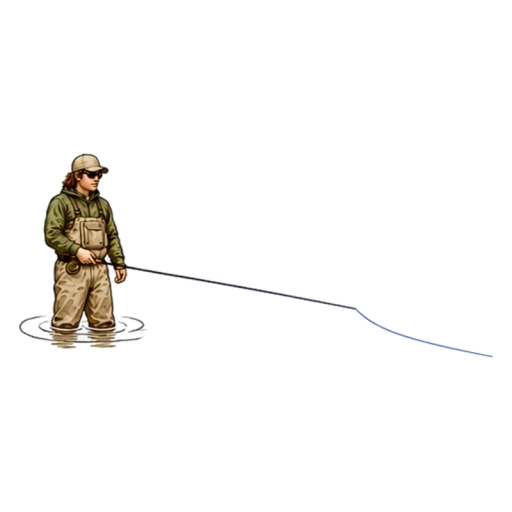
The idea: one continuous sweep
The single Spey is what's called a touch-and-go cast — the anchor briefly touches the water and lifts straight off again as you deliver, the whole thing happening inside one continuous sweep. You lift, sweep low at first, round up and over the anchor to form the D-loop, set the key position, then deliver forward. The sweep is a single unified movement, not an in-then-out — the forward stroke simply delivers what the sweep already set up.
Tip-low start
Start with the rod tip low and still, the line lying downstream in your mind's eye. A stable, low start gives the whole cast a clean reference point. Hold it for a beat before beginning the lift.
The smooth lift
The cast begins with a smooth lift that frees the line from the water, before any sweeping starts. Don't snatch it, and don't fire the wrist early — lift first, sweep after. A clean, unhurried lift here sets up everything that follows it.
Sweep back: the low first half
From the lift, sweep the rod back and round the upstream side, keeping it low. This is the first half of one continuous sweep, not a reversal or an in-and-out movement. Keep it smooth and unhurried — this is what actually sets the change of direction, and rushing it throws the whole cast off before the rod's even begun to rise.
Sweep round and up
The sweep now rounds and rises into the circle-up — the second half of that same continuous move, travelling the same direction as the low sweep, with no reversal and no dead stop in between. The farther you carry it round, the bigger the change of direction, and the better the D-loop that results.
Circle up into the key position
As the rod passes the anchor at the end of the sweep, circle it up and round — a rising, curved path that forms the D-loop and sets the key position. Pulling straight back flat instead of circling is the fault to watch for; the upward circle is what actually loads the rod for the delivery.
Set the D-loop and hold
At the top of the circle-up you reach the key position. Hold it for a short beat while the anchor and D-loop settle. Don't let your hand creep forward, and don't rush into the delivery from here — and this isn't only a style point. A D-loop or anchor that's crept onto the wrong side sends the delivery straight across your body instead of out over the water. Set, hold, then cast.
Forward delivery: speed late, stop high
Deliver with one smooth forward stroke, the speed building late, finishing with an abrupt, high stop. That crisp, high stop is what forms the loop and carries the line out; a soft or low stop lets the whole cast collapse. Hold the stop for a beat.
The full cast, together
Combine the whole sequence: start low, lift smoothly, then make one continuous sweep — low at first, then rounding up and over the anchor — circle up, set the key position, then deliver forward to a high stop. The sweep stays a single, unified move throughout, never an in-and-out. Let the D-loop actually form before you go; the sweep sets the cast up, the forward stroke is only there to deliver it.
How to practise the single Spey cast without water
Spey casting lives or dies on the sweep staying one continuous movement — low, then round, then up, with no seam where it stops and restarts. That seam is genuinely hard to feel from inside your own cast; it takes an outside read on the actual shape and tempo of the movement to catch it reliably.
That's exactly what Fly Cast Coach's motion sensors are reading when you hold your phone like a rod grip and run through the cast — the shape of the lift, the tempo of the low sweep into the rising round, how cleanly the circle-up sets the key position, and the crispness of the final stop, broken down phase by phase rather than collapsed into one number.
A useful way to feel the continuity on your own: try the sweep in slow motion, watching for any point where your hand pauses rather than simply slows down. A garden or a room with a bit of overhead room is enough space, since the goal is the shape of the movement, not distance. And because a real single Spey depends on real wind direction, a real anchor, and a real D-loop forming on real water, this practice builds the timing and the feel for the sweep — the river is still where the rest of it comes together.
See it on the water
How this cast actually gets used fishing a real river — from our sibling app, Rise Daisy:
Practise the single Spey
Your phone becomes the rod — scored phase by phase, no water required.
Open Fly Cast Coach