Tracking Guide: Keep Your Fly Rod on One Straight Path
Learn why tracking — keeping the rod in one straight plane through the whole cast — matters for tight loops and accuracy, plus how to practise it at home.
Tracking is the straightness of the path your rod tip travels through an entire cast — back and forward on the same invisible line, the way a train stays on a single length of track. It might be the simplest idea in this whole series to describe, and it's just as easy to lose without noticing: get it wrong and the backcast and forward cast stop lining up, which costs you both distance and accuracy — and gets dramatically worse the moment there's any wind around to punish it.
As with casting arc and wrist control, tracking isn't a cast of its own — it's a quality of technique that sits underneath every cast in this series.
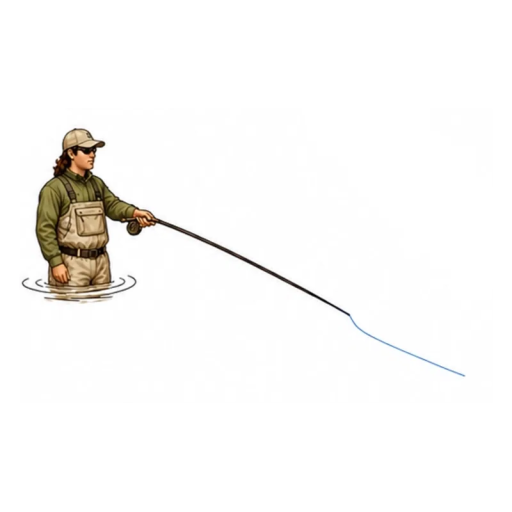
What good tracking looks like
The rod stays in one vertical plane through the entire stroke — back and through on the same line, with no cross-body sweep on the backcast that then has to be corrected on the way forward, and no gradual sideways drift as the stroke repeats.
Why mismatched tracking costs you
If the backcast travels on one lane and the forward cast comes through on a different one, the two loops — which need to travel in a continuous straight line for a clean transfer of energy — end up crossing or fighting each other instead of following through cleanly. Energy spent turning the corner between two different lanes is energy that isn't carried through to the target, and in any wind, even a small sideways component in your stroke gets amplified into real, visible drift in the finished cast.
Why this one is nearly impossible to feel yourself
Of every fault in this series, tracking might be the hardest to catch from inside your own cast — it feels, from the caster's seat, like you made the exact same stroke every time, because your hand genuinely did move through a similar-feeling motion. The actual drift only shows up in the flight of the line and loop, which is precisely the thing you're not watching while you're busy making the cast.
How to practise tracking without water
Because tracking is so hard to feel from the inside, it's the clearest case in this whole series for wanting an outside read rather than trusting your own sense of the stroke. Fly Cast Coach uses the phone's full orientation sensing — not just timing and speed, but the actual plane the phone travels through — to check three specific things: whether the forward stroke returns along the same lane as the backcast, whether the cast drifts sideways from rep to rep, and whether the plane stays steady all the way through the delivery.
A mirror only shows you one instant, and even a live side-on view is the wrong angle for this specific fault — sideways drift happens on the axis running toward and away from a side-on camera, which flattens it almost to nothing. What actually reveals it is a view from behind: prop your phone on something a few feet behind you (or have someone stand there) and film your rod tip travelling straight down your own sight-line, comparing the backcast and forward-cast lanes frame by frame. As ever, this builds the awareness and the correction — a real rod, line and loop are what ultimately confirm the plane actually held.
Sharpen your tracking
Your phone becomes the rod — scored phase by phase, no water required.
Open Fly Cast Coach