Wrist Control Guide: Timing Your Wrist in a Fly Cast
Learn why wrist timing — not wrist strength — makes or breaks a fly cast, and how to practise it at home.
The wrist is the smallest, fastest joint involved in a fly cast, and it's also one of the most common places a cast quietly goes wrong. Use it too early, or too much, and it takes over the whole stroke — the rod tip stops travelling in a straight line and starts drawing a curve instead, which is exactly what opens a loop and collapses a delivery. Get the timing right, and that same small joint is what turns an ordinary stop into a genuinely crisp one.
Like casting arc, this isn't a cast on its own — it's a quality of good technique that applies underneath the overhead cast, the roll cast, all of it.
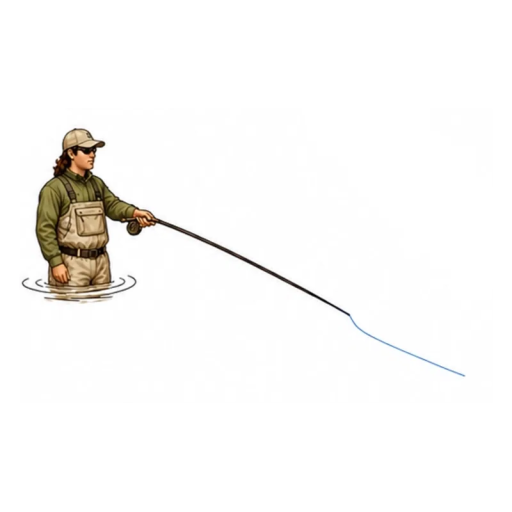
Hand and forearm carry the stroke
For most of any casting stroke, the hand and forearm should move together as one unit, rotating smoothly and keeping the rod tip on a predictable, straight path. The wrist, through this part of the stroke, stays essentially quiet — a passenger, not a driver.
The wrist only fires at the very end
A little wrist rotation adds a genuinely large amount of speed, which is exactly what makes it useful as the final touch into the stop — but only right at the very end. Think of it as a single sharp snap into the stop, not a wave that runs through the whole stroke. Fire it early, or let it contribute gradually the whole way through, and the rod tip's path stops being straight — the wrist joint changes the rod's angle mid-stroke, drawing a curve instead of a line, and a curved path is precisely what opens a loop.
What too much wrist, too early, actually looks like
This is one of the most common instincts in casting, especially for anyone reaching for extra power or distance — the wrist is the fastest, easiest joint to move, so it's the first thing an untrained hand reaches for. The result is a whippy, slapping motion, a loop that opens up rather than staying tight, and a fly line that loses its energy mid-flight instead of turning over crisply at the end.
How to practise wrist timing without water
Wrist timing is a genuinely hard thing to self-diagnose, because early wrist rotation doesn't feel like a mistake while you're making it — it feels like extra power. The only reliable way to know whether the wrist fired late (correct) or early (a fault) is an outside read on when, in the stroke, your fastest movement actually happened.
Fly Cast Coach reads exactly that: the timing of your stroke's fastest rotation, and whether the final stop is clean — no bounce, no flick — rather than trusting how the stroke felt from the inside.
A useful dry-practice drill on its own: deliberately keep the wrist locked for most of the stroke — hand and forearm only — and only let it unlock right at the very end, into the stop. Exaggerating a frozen wrist like this, even past the point of feeling natural, is a good way to feel where late actually is. As with every skill in this series, this builds the timing; a real rod and line are what show you what that timing actually does to a loop.
Sharpen your wrist control
Your phone becomes the rod — scored phase by phase, no water required.
Open Fly Cast Coach